EIS3 and SEIS3 certificates: when they arrive, why they haven't, and what to do about it
Tero team
The team behind Tero
3 min read
Updated 27 August 2026
SEIS & EISCertificates
Key takeaways
- No certificate, no relief, EIS3 and SEIS3 alike. The certificate is the only document that lets you claim, and it routinely arrives months after the money left your account. Everything here applies equally to both schemes.
- The company cannot send it until HMRC lets it. The company files a compliance statement (EIS1/SEIS1), HMRC authorises it (EIS2/SEIS2), and only then can the company issue your certificate. Any of those steps can stall.
- Chase at six months. If you invested more than six months ago and hold no certificate, ask the founder where the compliance statement is. Polite, specific, in writing.
Tero for angel investors
Let AI do the checking, then keep watching
- Run due diligence on any UK company. Nine AI agents read the registers, the courts and the founders' histories. Every figure cited.
- Add a holding to monitoring. Every filing on it, the week it lands, with what it means for your stake.
- Upload your EIS and SEIS spreadsheet. Export it as CSV. Tero maps the columns, starts every clock and chases the certificates.
Companies HouseFCAGazetteCourtsSanctions
Check a company free First report free, then plans from £10 a month. Descriptive verdicts, never a recommendation.
Every pound of EIS or SEIS relief hangs off one document: the EIS3 (or SEIS3) certificate. Investors tend to assume it turns up automatically. It often doesn't, and the gap between "I invested" and "I can claim" is where relief quietly goes missing.
What the certificate actually is
The EIS3 (SEIS3 for SEIS investments) is the company's confirmation, authorised by HMRC, that your subscription qualifies for relief. It carries the company's details, the amount you subscribed, the share issue date, and a unique investment reference (UIR). Your self-assessment claim draws on those details, and HMRC can ask to see the certificate itself.
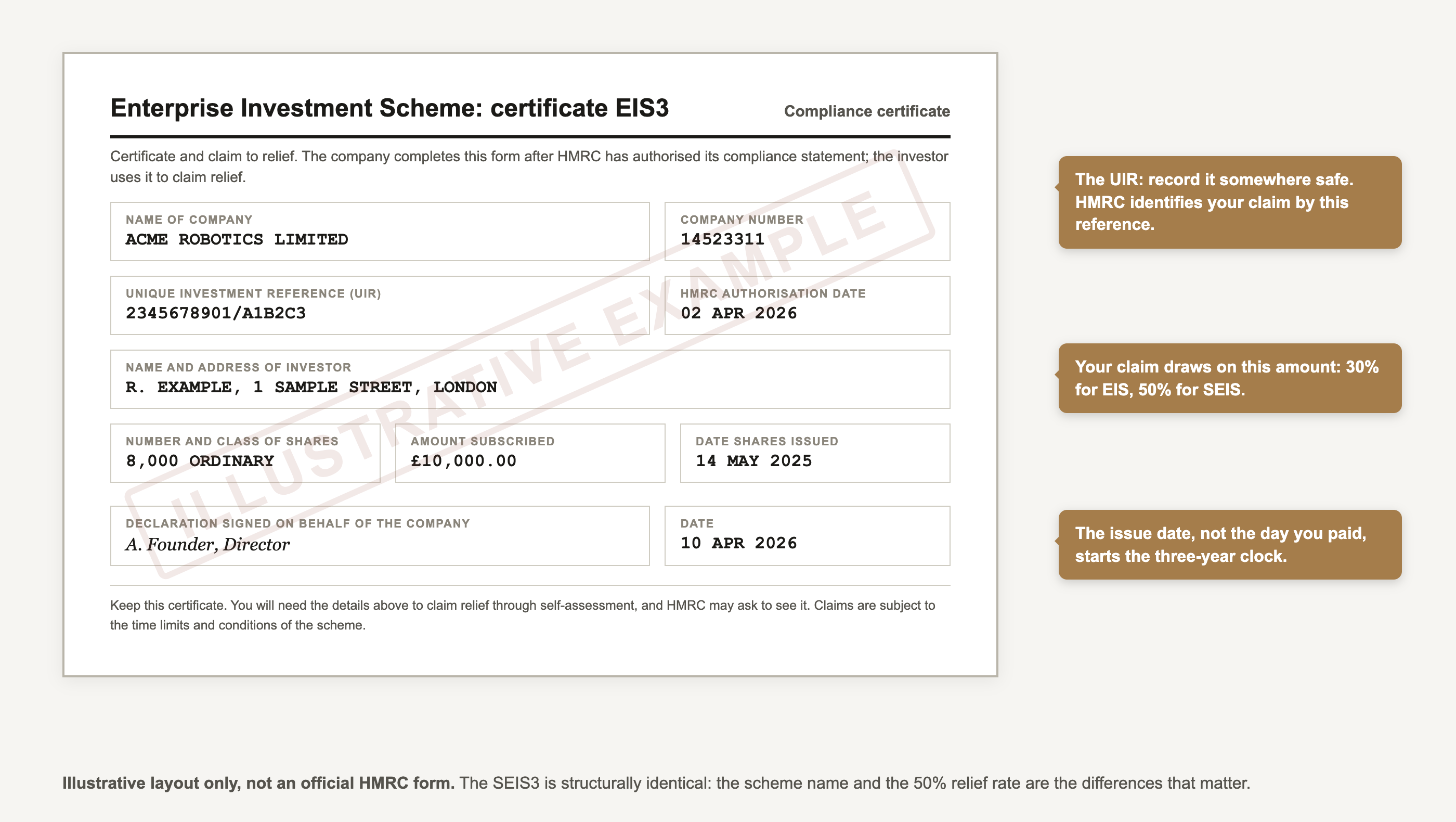
Why it takes so long
The company cannot simply print one. The sequence is:
The company must first meet the conditions: broadly, it must have been trading for four months or spent a substantial part of the money raised.
It then files a compliance statement (form EIS1) with HMRC.
HMRC reviews it and, if satisfied, issues an authorisation (EIS2).
Only then can the company produce your EIS3.
Each step has a queue. A well-run company with advance assurance often completes the chain in two to four months; a distracted founder can take a year, and some never file at all. None of this is visible to you unless you ask.
Each step has a queue. A well-run company with advance assurance often completes the chain in two to four months; a distracted founder can take a year, and some never file at all. None of this is visible to you unless you ask.
When will I receive my EIS certificate?
The honest ranges, from watching many rounds go through: a well-run company with advance assurance typically delivers EIS3/SEIS3 certificates two to four months after the shares are issued. Six to nine months is common when founders are slow to file the compliance statement. Beyond a year usually means nobody has filed at all, and the certificate will not arrive without a push from investors. If your certificate is outstanding at six months, move to the chasing rule below.
The practical chasing rule
If you invested more than six months ago and have no certificate, chase. Be polite, specific and in writing: "Has the EIS1 (or SEIS1) compliance statement been filed, and if so, when do you expect to issue the certificates?" Founders respond to specific questions far better than to "any update on the EIS stuff?". If the company has not filed and shows no intention of doing so, that is worth knowing early: without the compliance statement there will never be relief.
Lost certificates and missing details
If you had a certificate and lost it, the company can issue confirmation of the details; what your claim really needs is the information on it, especially the UIR, amount and issue date. Keep those recorded somewhere that is not a single sheet of paper in a drawer.
The hard case: the company fails first
If a company is dissolved before it ever filed its compliance statement, the relief on that investment is generally lost, because there is no company left to certify it. This is one more reason the six-month chase matters: the time to force the paperwork is while the company is alive. (Failure after relief has been claimed is a different, better story: see how loss relief works.)
Keeping this on autopilot
The certificate problem is really a tracking problem: per holding, you need to know invested-on, certificate received or outstanding, and how long it has been outstanding. Tero's tax relief tracker keeps that per position and flags the holdings where the certificate is overdue for a chase. The claim deadlines guide covers what happens after the certificate arrives. Information, not tax advice; confirm your position with your adviser.
From the register
See it on a real filing history
Three UK companies whose priced rounds Tero has read from Companies House, with implied valuation at each allotment.
Questions this guide answers
- When will I receive my EIS3 certificate?
- A well-run company with advance assurance typically issues EIS3 or SEIS3 certificates two to four months after the shares are issued. Six to nine months is common when the compliance statement is filed late.
- Why can't the company just send the certificate?
- It must first have traded for four months or spent a substantial part of the money, then file a compliance statement, form EIS1 or SEIS1. HMRC authorises it with an EIS2 or SEIS2, and only then can the company issue certificates.
- What should I do if my EIS3 hasn't arrived?
- If you invested more than six months ago, ask the founder in writing whether the EIS1 or SEIS1 compliance statement has been filed and when certificates will be issued. Specific questions get answers.
- What if the company fails before issuing certificates?
- If it is dissolved before filing its compliance statement, the relief on that investment is generally lost, because no company remains to certify it.
Tero runs these checks automatically.
Twelve sources, one gateway. Diligence in minutes, monitoring forever.